

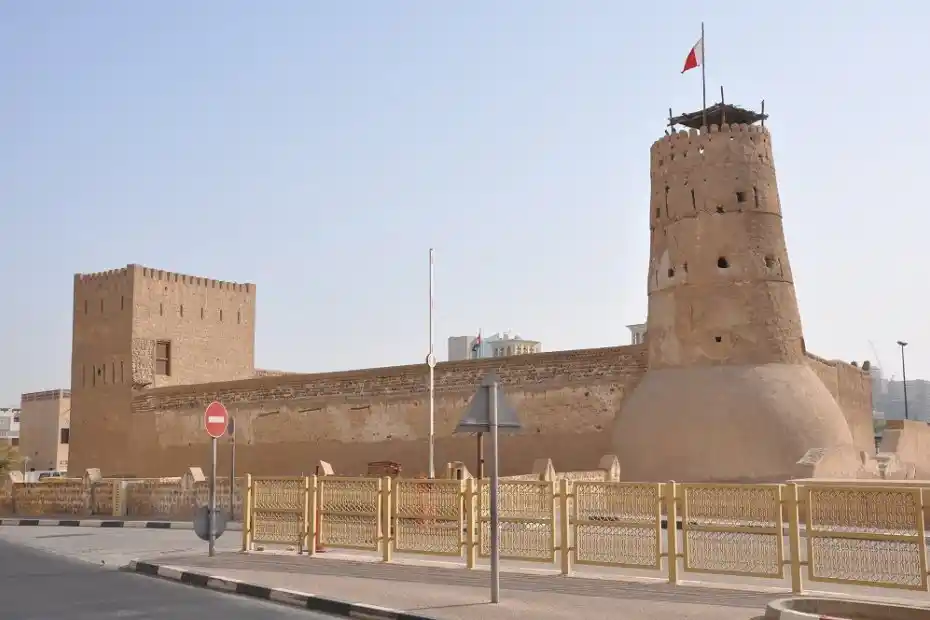
Dubai, the glittering city of futuristic skyscrapers and unparalleled luxury, holds a secret: a deep, rich history often overshadowed by its modern marvels. To truly understand the soul of this global hub, one must journey to the Al Fahidi Fort, a timeless sentinel that is the city’s oldest standing structure.
Built in 1787, this magnificent coral-stone fortress pre-dates the electric lights and glass towers by centuries, having witnessed the Emirate’s entire journey from a humble fishing and trading settlement to the global metropolis it is today. Housing the renowned Dubai Museum, the fort acts as a powerful, living bridge connecting the past with the present, inviting visitors to uncover the fascinating traditional life that thrived here long before the oil boom.
A Fortified Foundation: The Birth of a Defensive Stronghold
The Al Fahidi Fort was originally constructed in 1787, giving it a powerful 238-year history, making it the bedrock of Dubai’s defence. Its initial purpose was purely strategic: a mighty bulwark built from local materials like coral stone and gypsum, designed to guard the landward approaches to the burgeoning settlement along the Creek and protect the community from invasion.
Over the decades, the thick, robust walls and strategic watchtowers proved their worth, not only as a military garrison but also evolving to serve as the residence for the ruling family and the official seat of government. Today, this historic site stands in sharp contrast to modern landmarks like Dubai Mall, yet the structure itself, with its simple yet ingenious traditional architecture, represents the resourcefulness and resilience of early Emirati life.
From Royal Seat to Repository of History
As Dubai’s role shifted from a defensive outpost to a vital trading port in the Arabian Gulf, the fort’s function also changed. It continued to house the ruler for a time, but later saw use as an arsenal for weapons and even a prison. It was a silent witness to the city’s slow, steady growth, centred around pearl diving and trade.
Recognising its immense cultural value, the late Sheikh Rashid bin Saeed Al Maktoum initiated a transformation. Finally, in 1971, coinciding with the formation of the United Arab Emirates, the fort was meticulously restored and officially opened as the Dubai Museum. This move cemented its status as a premier guardian of national heritage.
Immersive Exhibits: The Pre-Oil Era Brought to Life
Graced with air-conditioned spaces behind its ancient walls, the museum’s life-size dioramas and interactive displays take you back in time to pre-oil days. The displays are so alive you feel as if the sprit of a souk with its sights and sounds from sellers and artisans is around every turn. You can wander into dioramas of Bedouin desert existence, with detailed tents and paraphernalia, as well as an ample section to the foundation of early industry: pearl diving and all things nautical. These galleries detail the ingenious response of an indigenous people to their hostile desert environment and their intimate relationship with the sea.
Heritage Meets Modernity: The Surrounding Al Fahidi District
Another building belonging to an Iranian merchant, Shaikh Obaid, that was constructed in 1780 and is now a museum as the Al Ahmadiya School. It also stands at the Al Fahidi Historical Neighbourhood (Bastakiya). This revived district is a maze of narrow, labyrinthine paths and old-style buildings, complete with Barjeel (wind towers), an ancient pre-air conditioning feature.
From the fort’s history tour, visitors can wander around a cobbled community with adorable art shops, cultural centres and cosy cafes. This area of town, anchored by the Dubai Museum (also miraculously intact) where the modern city gleams in all directions, he says, offers a much fuller picture both of Dubai’s past and our own future when you take it with everything else.
Navigating Dubai’s Historical Heart
The Al Fahidi Fort is conveniently located to the Dubai Creek and is a great starting point for discovering Old Dubai. Taking a short abra boat ride (a traditional water taxi) across the Creek brings you to spice and gold souks, adding another layer of history. But let’s say the giant, iconic Dubai Mall is all-you-can-handle modern shopping (peckish or no). In which case, visiting here serves as an important historical footnote, putting the story of how the future perfect pan-city destination came to be into perspective.
- The fort is constructed with typical local materials like coral stone and gypsum.
- It was constructed mostly as a fortress against invasion.
- It was the ruler’s palace before it became a museum, as well as an arsenal and prison.
- The museum’s displays take in daily life, pearl diving and pre-oil Bedouin culture.
- It’s part of the expansive, historically preserved Al Fahidi Historical Neighbourhood.
FAQ,s
When was Al Fahidi Fort built?
Al Fahidi Fort was built in 1787, making it the oldest existing building in Dubai.
What is the main focus of the Dubai Museum inside the fort?
The museum’s main focus is showcasing the traditional way of life and the rapid development of Dubai before the discovery of oil.
Is the Al Fahidi Fort near the main tourist areas?
Yes, it is centrally located in Old Dubai, close to Dubai Creek and the traditional souks.
Conclusion
But the Al Fahidi Fort, you see, isn’t just a very old building; it’s a monument to Dubai’s evolution into a city. The 238-year evolution of the city – from a small, trading and pearl diving town on the coast to today’s bustling cosmopolitan place – is nothing short of breathtaking. By preserving the stories, artifacts and architecture of pre-oil, the fort also ensures that much of the Emirati spirit and culture remains vibrantly alive. Come here and you will find the sort of context that this city’s head-spinning modernity cannot provide. It’s a fantastic educational thing to do if you want to unravel the backstory of how modern-day Dubai came about.


